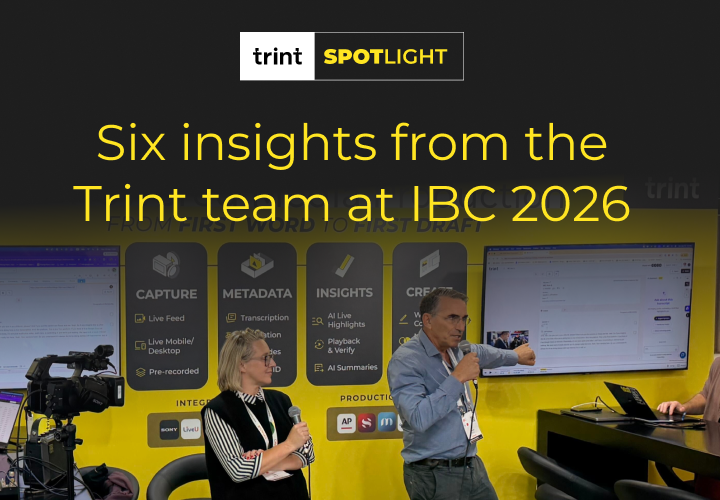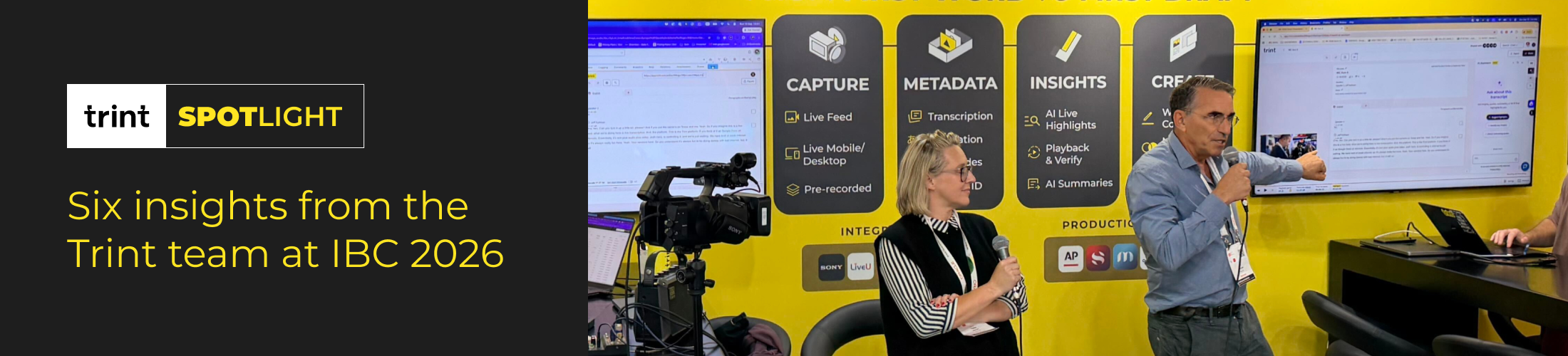
You may have heard by now, but over 11th-14th September, the team headed off to Amsterdam for IBC 2026. They spent the long weekend demoing our AI-connected media production, chatting to prospective and current customers and generally enjoying the atmosphere of one of our favourite events. We got them to share their top takeaways and here’s what they had to say:
One of the biggest takeaways from IBC was the confirmation that infrastructure is replacing the destination-tool model. Capabilities are embedding across workflows – we’ve seen TVU, LiveU, Sony, and Cutting Room reinforce the shift around intelligence flowing from capture to production. In parallel to this, while AI has become agentic, the context is the missing layer. We’ve seen that shared context and interoperability are the foundation for agentic workflows to succeed and thrive.
Another thing is that more and more organizations are asking us about integrations, looking for Trint intelligence to be where they are already working. Focusing on “NRCS”, the MCP Connector and ingest transcription, they want to see Trint beyond the Trint UI. What’s more, live is evolving from transcription to real-time intelligence. Customers increasingly want to act on content as it happens. They’re looking to be able to monitor important topics, surface key moments and make them usable downstream, all within that live window.
Mark Steinmeyer, Chief of Staff
If I took one thing away it is that the industry is far beyond the point of being impressed by flashy AI feature demos. Conversations at IBC were about how to make AI workflows reliable, auditable, and scalable across real broadcast scenarios – which is exactly why people were talking about standards, not just capabilities.
That's why we got involved with the Story Object Model: shared context is essential for most agentic tools to be truly valuable beyond a proof of concept or small use case. So we are going to continue working with broadcasters and partner tools to keep pushing forward that work. But it also means that when we build AI functionality within Trint, we have to make sure we never think of them as standalone features. That means making them available for whole teams working across thousands of hours of footage, and in the newsroom systems people already run – whether through integrations with our partners or through APIs and MCPs.
Tessa Kaday, VP Product
Trint is recognised by more people than you'd think. The number of people who come up to the booth and say something kind about us always catches me off guard. A couple of years ago, plenty of people were saying transcription wasn't a viable product anymore, since it now comes free with so many tools on the market. But we've proven that Trint goes well beyond transcription and empowers people across the news and media space.
Our integrations with the likes of Mimir and Octopus really set us apart and solve real world workflows. It was great to connect with so many of my customers during the event. Meeting them in person and giving them the chance to share their requests and feedback face to face is genuinely valuable.
Chester Hawkins, Customer Success Manager
I got a chance to see industry leaders "unveiling" the Story Object Model (SOM). The idea being that there is a central, industry accepted, framework to capture the context, encode editorial standards, and ultimately help tools that can "DO" the work to "UNDERSTAND" the work. I'm eager to see the impact/feedback/evolution of the SOM in the newsroom.
Last but by no means least, trust is more important than ever. Professional media demands security, attribution, and auditability alongside the growth in AI adoption. As AI usage continues to grow, so does the need for complete trust and authenticity in everything we do.
Josh Morrow, Senior Account Executive
IBC 2026 felt less like AI hype and more like AI actually shipping. Vendors were showing agents doing specific jobs (QC, compliance, metadata) rather than "AI does everything" pitches, alongside a real push toward shared infrastructure (MXL) instead of walled gardens.
A consistent theme every client conversation came back to was speed. That's exactly why we're moving SRT export into beta – faster caption turnaround, right when the market's asking for it.
The one I also can’t not mention is the Story Object Model (SOM) launch. One line from the show stuck with me: a story starts as "an empty backpack" that fills up with context (transcript, metadata, provenance) as AI agents help move it through production, with editorial approval staying human. Transcription output is exactly the kind of structured context that backpack needs, which is where we fit.
Kirill Garbar, VP Engineering
What we saw at IBC 2026 was the beginning of a new era of software. Over the last two years we watched the LLMs transform how tasks are done. What’s clear is that what is needed now is a seamless workflow that can carry content, metadata and attribution as media moves through the workstream and from one product to the next. That requires a rearchitecture – or at least a revision – of the underpinnings of the software that power newsrooms and content productions. We got a preview of that in Amsterdam. Once it’s in place media production workflows will be transformed in ways we could have only dreamed just a few years ago.
Jeff Kofman, Founder & CEO