Information in this article was accurate as of November 2026
Confidential material is everywhere. Somewhere in your building there might be a recording that can't leak. A whistleblower interview. A source off the record. Raw footage from a story that hasn't cleared legal yet.
That recording still needs transcribing, usually fast and usually by several people at once. And that's where things can get tricky. Drop it into the wrong tool and you may have just sent confidential recordings to servers you can't locate, to staff you've never vetted, or to an AI model that's quietly learning from your private content.
For UK broadcast teams, choosing secure transcription software is part of protecting sources, meeting UK GDPR, and keeping editorial control where it belongs: with you. This guide sets out the important criteria points then compares the key broadcaster transcription tools most teams are weighing up so you can make the best choice for yourself and your team.
Every vendor will say it takes data privacy seriously. Not all of them will be able to prove it.
Data residency decides which laws govern your files. Post-Brexit, UK broadcasters need a clear answer on where recordings are stored and processed, and how any transfer outside the UK is covered under UK GDPR.
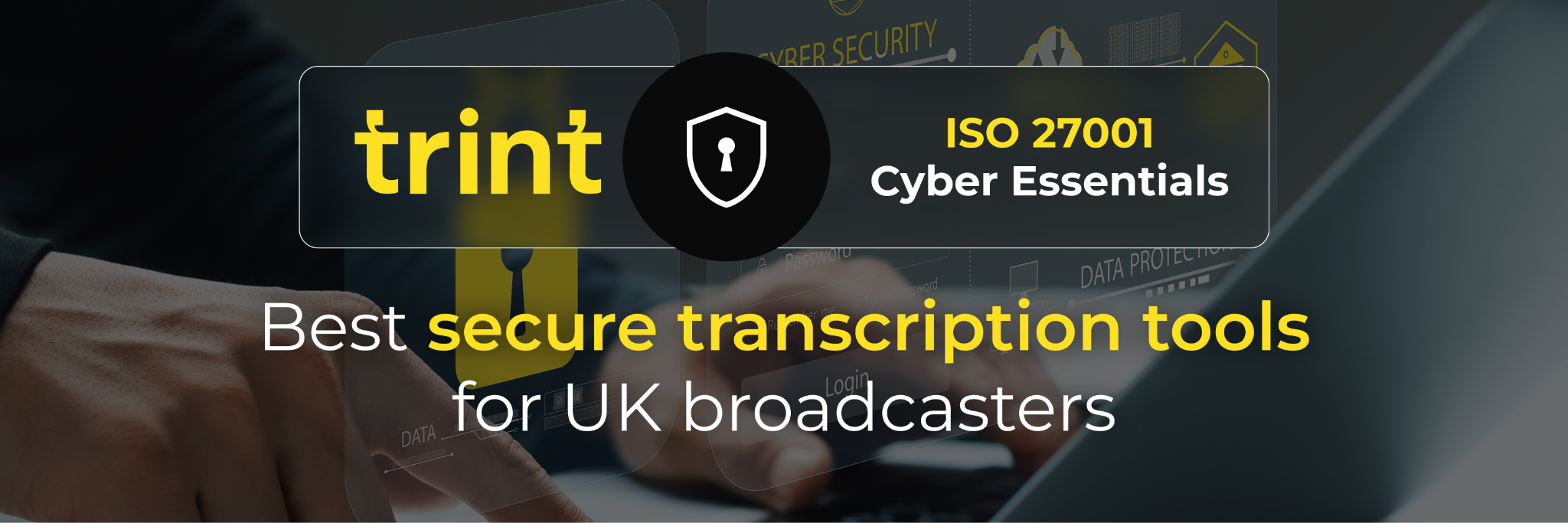
Look for independent certifications. ISO 27001 and SOC 2 show a vendor's security is audited by a third party. Cyber Essentials is the UK government-backed baseline, and it's often on public-sector suppliers' checklists.
Audio transcription security is as much about people as servers. You want single sign-on (SSO), user provisioning, and permissions granular enough that when needed, a freelancer sees just the one project, not the whole archive.
Some secure speech-to-text providers improve their models using customer recordings, or let human reviewers listen in. For an unaired investigation, that's a hard no. Check the terms, not just the FAQs.
You should control how long files are kept and be able to permanently erase them, ideally with a clear retention policy you can show your legal team if needed.
A tool that's locked down but slow just pushes journalists back to their phones and personal apps. The secure option has to be the most practical option too: fast turnaround, shared editing, and quick ways to find and clip the moments that matter.
A disclosure, we’ve put ourselves first here not only because it’s our article but also because we have the most knowledge about our own security. Tools mentioned below have strong transcription capabilities and different security policies. The right one depends on what you're recording and who needs to see it.
For more granular details on any of the tools below, get in touch with the companies directly and ask those six questions.
Trint’s founder Jeff Kofman, a former foreign correspondent, designed Trint around how broadcast teams actually work. On security, Trint has been ISO 27001 certified since 2019 and is Cyber Essentials certified. Files are encrypted in transit and at rest with AES-256, and you can choose whether data is stored in the EU or the US.
The part editors might care about most: Trint never uses your recordings to train its algorithms, and employees can't view your data without your strict permission. SAML single sign-on, SCIM provisioning, and granular permissions keep access tight across big teams.
Best for: Broadcast and news teams that want security and an end-to-end editorial workflow in one place.
Happy Scribe stores files in an EU data center certified to ISO 27001, and the company itself holds SOC 2 Type II. Data is encrypted with AES-256, and its optional human transcribers work under NDA. It's a solid pick for secure subtitling and multilingual work.
Best for: Teams prioritizing subtitles and languages with EU data storage.
Otter holds a SOC 2 Type II attestation and encrypts data in transit and at rest. It's quick and easy for capturing meetings. Data is stored on US infrastructure, and Otter trains its models on de-identified user data, unless you opt out.
Best for: Internal meetings, rather than confidential source material.
Rev holds SOC 2 Type II and processes and stores all customer data in the US. It doesn't let third parties train on your content, and you can purge files whenever you like. The human transcription service uses vetted freelancers for that extra accuracy but may mean more people hear the audio.
Best for: Teams that need human-verified transcripts and are comfortable with US data storage.
Sonix also holds SOC 2 Type II attestation and handles a wide range of languages quickly. Its SOC 2 report is only shared with Enterprise customers, so smaller teams may need to ask for more detail on data location and retention before uploading anything sensitive.
Best for: Multilingual teams after fast, affordable automated transcripts.
*Vendor details as published on their own sites and reputable sources as of October 2026. Policies change, so please confirm with them directly.
For full confidence in the vendor you choose, take these questions to any demo:
The most secure option is one with independent certification (such as ISO 27001 or SOC 2), a clear data residency choice, a contractual promise not to train AI on your content, and granular access controls.
It can be, if the provider encrypts files, limits who can access them, and doesn't use your recordings to train its models. Always check the terms of service.
Yes. Recordings and transcripts often contain personal data, so the provider acts as a data processor. You'll need a data processing agreement and clarity on where data is stored.
Both are independent security audits. ISO 27001 is an international standard widely recognized in the UK and Europe. SOC 2 is an attestation and US framework. Either is a strong signal; however neither replaces checking data residency and AI training policies.